GEOTECHNICALENGINEERING1
POMONA
HomeLaboratoryTriaxial test

Advanced Triaxial Testing in Pomona: Shear Strength & Soil Behavior Analysis

Rigorous testing. Clear reporting.

LEARN MORE

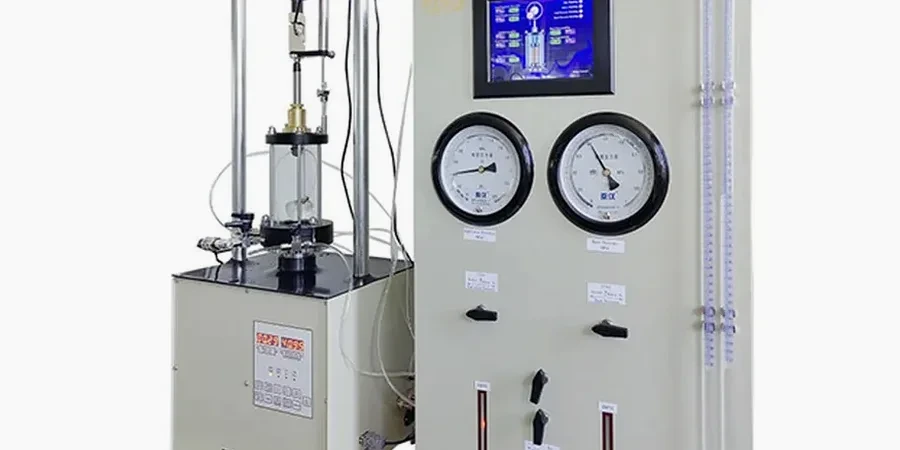
The 2022 edition of the California Building Code, referencing ASCE 7, places significant emphasis on site-specific soil parameters for seismic design categories D through F — a direct concern for projects throughout Pomona’s varied alluvial terrain. The triaxial test provides the most accurate method for determining drained and undrained shear strength, something standard direct shear simply cannot replicate when pore pressure conditions matter. For geotechnical engineers working in the city’s transitional zone between the San Gabriel Mountains fan deposits and the Chino Basin, the consolidated-undrained (CU) test with pore pressure measurement becomes indispensable. We run these advanced procedures in our accredited soils laboratory, delivering the effective stress parameters — c' and φ' — that structural engineers need for IBC-compliant foundation calculations. Complementing this, a CPT test often guides the initial selection of critical depths where undisturbed sampling becomes necessary before the triaxial program begins.

The difference between a well-designed foundation and a settlement-prone one often lies in a single triaxial test on an undisturbed sample from the critical depth.
Our service areas

Our approach and scope

The semi-arid climate of Pomona — with 17 inches of annual rainfall concentrated in just a few winter months — creates distinct seasonal saturation cycles in the near-surface silty sands that dominate much of the city. These fluctuations directly impact matric suction and, consequently, the undrained shear strength of compacted fill materials. Our triaxial testing program addresses this by providing separate strength envelopes for both as-compacted and saturated conditions. We follow ASTM D4767 for consolidated-undrained tests on cohesive soils and ASTM D2850 for unconsolidated-undrained tests where immediate strength is the design concern. The test program typically requires three specimens consolidated at different effective stresses: 5 psi, 10 psi, and 20 psi for shallow foundation analysis, or scaled higher for deeper bearing strata. Each specimen undergoes shearing at a rate of 0.05 inches per minute to ensure full pore pressure equalization, particularly critical when testing the low-permeability clay lenses found in the city’s eastern sections. Beyond the standard Mohr-Coulomb envelope, we also prepare p-q diagrams for total and effective stress paths, giving the design team a complete picture of soil behavior from the start of loading through failure.
Advanced Triaxial Testing in Pomona: Shear Strength & Soil Behavior Analysis
Technical reference — Pomona

Local geotechnical context

Pomona’s historical development, from its agricultural roots as part of the Rancho San Jose land grant to its post-war industrial expansion along the 60 Freeway corridor, has left a complex legacy of undocumented fill across the city. Portions of the downtown core sit on reworked alluvium that was graded and compacted to standards far below today’s IBC requirements. When a new mixed-use project breaks ground on Holt Avenue or a warehouse rises near the Fairplex, the geotechnical profile often reveals compressible layers interbedded with granular lenses — a recipe for differential settlement if shear strength is mischaracterized. The triaxial test becomes the forensic tool that prevents this: a CU test with pore pressure measurement can reveal whether that silty clay at 12 feet will drain during construction loading or hold excess pressure that reduces effective stress for months. The cost of skipping this step is not theoretical; it manifests as tilted floor slabs, cracked masonry, and eventual underpinning work that dwarfs the original investigation budget. We have seen projects where a single triaxial test at the right depth changed the foundation recommendation from shallow spread footings to a ground improvement solution, saving the owner from a latent defect claim down the road.

Need a geotechnical assessment?

Reply within 24h.

Email: info@geotechnicalengineering1.com

Relevant standards

ASTM D4767-11: Standard Test Method for Consolidated Undrained Triaxial Compression Test for Cohesive Soils, ASTM D2850-15: Standard Test Method for Unconsolidated-Undrained Triaxial Compression Test on Cohesive Soils, IBC 2024 Section 1803: Geotechnical Investigations, Caltrans Standard Specifications Section 39: Earthwork

Typical values

ParameterTypical value
Specimen diameter1.4 in (35 mm) or 2.8 in (71 mm)
Confining pressures (typical)5, 10, 20, 40 psi
Shear strain rate (CU test)0.05 in/min for cohesive soils
Pore pressure parameter B≥ 0.95 for full saturation
Failure criterionMax deviator stress or 15% axial strain
Sample saturation methodBack-pressure saturation per ASTM D4767
Reported parametersc', φ', cu, E50, σ13
Sample conditionUndisturbed (Shelby tube) or remolded at specified density

Common questions

What is the typical turnaround time for a triaxial test program in Pomona?

A standard CU triaxial program with three specimens takes 5 to 7 working days from sample extrusion to final report. UU tests can be completed in 3 to 4 days. Expedited service is available when foundation design deadlines are tight, particularly during the busy summer construction season when Pomona's public works and private development projects overlap.

What does a triaxial test cost for a project in Pomona?

A complete CU triaxial program with pore pressure measurement on three undisturbed specimens typically ranges from US$1,640 to US$2,890, depending on the number of samples and whether effective stress or total stress parameters are required. The final scope is determined after reviewing the boring logs to identify the critical depths that will govern the foundation design.

How does the triaxial test differ from a direct shear test for Pomona's soils?

The triaxial test controls drainage and measures pore pressure throughout the test — direct shear does neither. For Pomona's silty clays, which can generate significant excess pore pressure under loading, the triaxial test gives the effective stress parameters (c' and φ') that govern long-term stability. Direct shear provides only total stress parameters, which can be unconservative for saturated fine-grained soils. When groundwater is within the influence zone of the foundation, the triaxial test is the appropriate choice under IBC 2024.

Location and service area

We serve projects in Pomona and surrounding areas.

View larger map