GEOTECHNICALENGINEERING1
POMONA
HomeIn-Situ TestingField density test (sand cone method)

Field Density Testing in Pomona: Reliable Sand Cone Method

Rigorous testing. Clear reporting.

LEARN MORE

Working in Pomona, where the alluvial fans from the San Jose Hills meet the younger sediments of the Pomona Valley, we consistently encounter a mix of sandy loams and gravelly deposits that make compaction verification non-negotiable. A driveway poured on loosely placed fill over these old creek beds can show distress within two seasons. Our team performs field density tests using the sand cone method to confirm that every lift of backfill meets the specified relative compaction before concrete or asphalt is placed, integrating the results with Atterberg limits to understand how the fine fraction of the soil will behave when moisture fluctuates during Southern California's dry summers and occasional intense winter rains.

In the decomposed granite soils common across Pomona, achieving 95% relative compaction often requires moisture conditioning within a narrow 2% window.
Our service areas

Our approach and scope

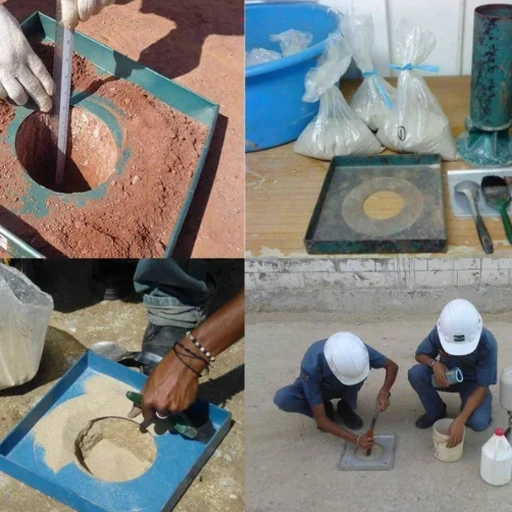
The sand cone apparatus itself is elegantly simple but demands rigorous procedure: a calibrated one-gallon jar filled with uniformly graded Ottawa sand, attached to a metal cone valve and base plate with a precisely machined 6.5-inch diameter opening. In Pomona's compacted trench zones, the technician excavates a carefully controlled test hole, weighing every gram of removed soil and measuring its moisture content with a speedy moisture tester on site. The known density of the sand, calibrated daily against our laboratory's reference standard, allows calculation of the in-place dry density. For pavement subgrade layers along corridors like Garey Avenue, we frequently pair this with CBR testing to correlate the achieved density with the anticipated bearing strength for the pavement design.
Field Density Testing in Pomona: Reliable Sand Cone Method
Technical reference — Pomona

Local geotechnical context

The compaction requirements in the historic downtown residential blocks near Lincoln Park, where older alluvial soils dominate, differ markedly from the engineered fills near the Fairplex area, which sit on deeper, more recent sedimentary layers. In the downtown zone, undocumented historical fills containing brick fragments and ash can create density anomalies that a nuclear gauge would misread entirely, making the physical sand cone method the only reliable arbitration tool. If these pockets go undetected, differential settlement can shear rigid utility connections within a few years. Our technicians flag these inconsistencies immediately using field observations of the excavated material, cross-referencing the gradation with the compaction curve to ensure the assumed Proctor target actually represents the material being tested.

Need a geotechnical assessment?

Reply within 24h.

Email: info@geotechnicalengineering1.com

Relevant standards

ASTM D1556: Standard Test Method for Density of Soil in Place by the Sand-Cone Method, ASTM D698 / D1557: Standard Test Methods for Laboratory Compaction Characteristics (Proctor), IBC Chapter 18: Soils and Foundations, Caltrans Standard Specifications Section 19: Earthwork

Typical values

ParameterTypical value
Standard Test MethodASTM D1556 / AASHTO T 191
Calibration SandASTM C778 20-30 Ottawa Sand
Base Plate Diameter6.5 in (165 mm) minimum
Test Hole VolumeApprox. 0.1 ft³ (varies by max particle size)
Typical Field Accuracy± 2% of laboratory Proctor value
Maximum Particle Size2 in (50 mm) for standard apparatus
Reporting FormatDry density, wet density, percent compaction

Common questions

At what depth can the sand cone method be used effectively?

The sand cone method is ideal for near-surface tests, typically within the upper 12 inches of a compacted lift. For deeper verification, the test hole can be carefully extended, but the method becomes less practical below about 18 inches because of the difficulty in excavating a clean hole and recovering all loose material. In those cases, we coordinate with the contractor to perform tests as each lift is placed.

How much does a sand cone density test cost in Pomona?

For projects in Pomona, individual sand cone field density tests typically range from US$110 to US$140 per test location, depending on the number of tests scheduled per mobilization and the accessibility of the site. A minimum mobilization fee may apply for very small projects. We provide a firm quote after reviewing the compaction specifications and the project's test frequency table.

How does the sand cone compare to a nuclear density gauge?

The sand cone is a direct physical measurement of volume and mass, making it immune to the material composition errors that can affect nuclear gauges in soils with high mica, iron, or organic content. While slower than a nuclear gauge, it serves as the referee method and is required for calibration checks of nuclear equipment. In Pomona's variable fills, we often recommend sand cone testing for the first several lifts to validate the nuclear gauge readings before switching over.

What is the minimum number of tests required for a residential foundation?

For a typical single-family home foundation pad in Pomona, the geotechnical engineer usually specifies a minimum of one field density test per lift per 2,000 ft² of building area, with at least four tests across the pad for smaller footprints. For trench backfill around the foundation perimeter, the frequency typically increases to one test per 50 linear feet of trench per lift. We always follow the project's approved soils report frequency.

Location and service area

We serve projects in Pomona and surrounding areas.

View larger map