GEOTECHNICALENGINEERING1
POMONA
HomeRoadwayRigid pavement design

Rigid Pavement Design for Pomona's Variable Geotechnical Conditions

Rigorous testing. Clear reporting.

LEARN MORE

The contrast between the decomposed granite slopes of Phillips Ranch and the deep alluvial deposits near the 71 Freeway is significant. In Phillips Ranch, you might find weathered bedrock within five feet. Down by the Fairplex, you can drill twenty feet and still be in silty sand. This variation across Pomona means a standard pavement section rarely works. We see joints faulting in industrial parks because the base saturation wasn't modeled correctly, or curling cracks on bus pads where the concrete mix didn't account for the valley's 40-degree diurnal temperature swing. A rigid pavement design here has to start with the subgrade, not the slab. We rely on our test pits to visually log the stratification, then pull undisturbed samples for lab analysis. For heavily loaded corridors, we also correlate findings with CPT soundings to catch soft lenses that a boring might miss.

A rigid pavement's service life is determined before the first pour. Get the k-value wrong on Pomona's alluvial fans and you are designing a replacement, not a road.
Our service areas

Our approach and scope

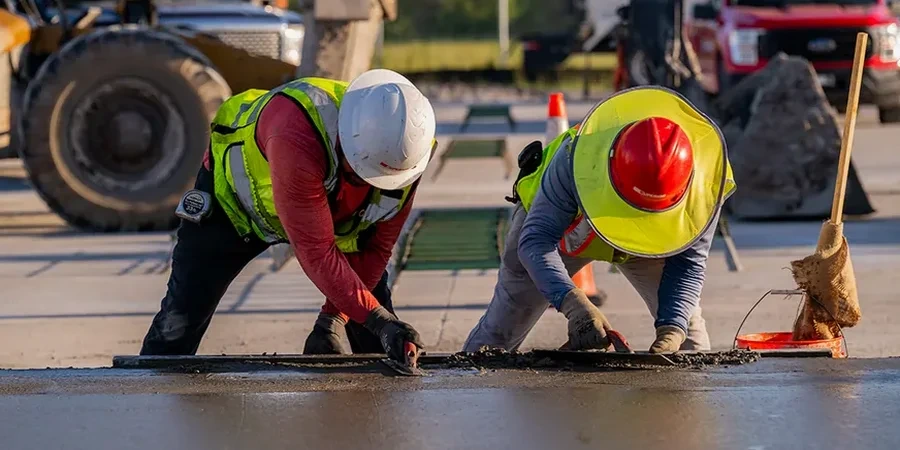
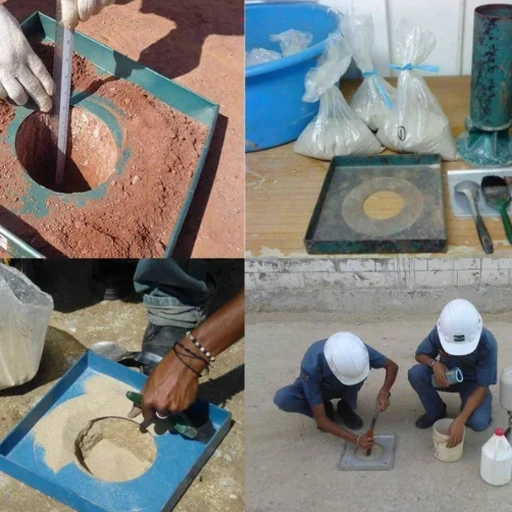
The slip-form paver is only as good as the mix design behind it. For Pomona projects, we specify the combined aggregate gradation using ASTM C33 and the local alluvial sands from the San Gabriel wash. Our lab runs the complete fresh concrete battery: slump, air content by the pressure method, and unit weight, all before the first truck empties. We model the pavement structure using the PCA method, inputting the modulus of subgrade reaction (k-value) derived directly from our on-site plate load tests. The joint layout is dictated by the panel aspect ratio, never exceeding 1.25, and we detail the load transfer through dowel bars sized per AASHTO 1993. Dowel alignment is critical; a misaligned basket in the lanes of Mission Boulevard will lock the joint and cause a spall within the first thermal cycle. We also specify the curing compound's application rate based on the ambient wind speed and the concrete's bleed rate, ensuring the membrane forms correctly under Pomona's often dry Santa Ana conditions.
Rigid Pavement Design for Pomona's Variable Geotechnical Conditions
Technical reference — Pomona

Local geotechnical context

The Pomona segment of the San Jose Fault, though not as active as the Sierra Madre front, introduces a lateral spreading risk in the liquefiable soils mapped south of Holt Avenue. A rigid slab is brittle; differential movement of 0.25 inches across a joint can trigger a corner break. We analyze the seismic demand using the site-specific peak ground acceleration from ASCE 7-22, not the default default IBC map value, because the basin effects here can amplify the spectral acceleration at 1.0-second periods. The second major risk is moisture warping. The clayey silts common at depths of 3 to 6 feet exhibit high volume change with seasonal moisture fluctuation. If the slab is cast directly on a moisture-sensitive subgrade without a positive drainage layer, the edges curl up, losing support. We mitigate this with a daylighted permeable base and edge drains that outfall to the city's stormwater system. Ignoring this detail results in pumping at the joints, visible as white fines on the pavement surface after the first heavy rain.

Need a geotechnical assessment?

Reply within 24h.

Email: info@geotechnicalengineering1.com

Relevant standards

ASCE 7-22 (Minimum Design Loads for Buildings and Other Structures - Seismic), ASTM C33 / C33M (Concrete Aggregates), AASHTO Guide for Design of Pavement Structures 1993, ASTM D1196 (Nonrepetitive Static Plate Load Tests of Soils), IBC Chapter 18 (Soils and Foundations)

Typical values

ParameterTypical value
Subgrade k-value determinationASTM D1196 (Plate Load Test on in-situ soil)
Concrete flexural strength650 psi (4.5 MPa) at 28 days (MR target)
Joint spacing (longitudinal/transverse)12 to 15 ft (panel aspect ratio < 1.25)
Base course permeabilityMinimum 150 ft/day (open-graded drainage layer)
Dowel bar diameter1.25 inches for 8-10 inch slabs (AASHTO)
Tie bar spacing30 to 36 inches on center (deformed Grade 60)
Subbase compaction control95% modified Proctor (ASTM D1557)

Common questions

What is the typical rigid pavement design thickness for a warehouse floor in Pomona?

For a standard warehouse with rack loads, we typically start at 6 to 8 inches of unreinforced concrete, depending on the subgrade k-value. If you're running high-bay reach trucks with small, hard wheels, the flexural stress analysis often pushes the thickness to 10 inches at the joints.

How do you prevent cracking on Pomona's alluvial fan soils?

Cracking is controlled by three factors: a stable, non-expansive subbase, correctly spaced contraction joints, and adequate curing. On Pomona's silty fans, we saw-cut the joints within 8 hours of finishing to capture the shrinkage before the concrete's tensile capacity is exceeded. We also specify a 4-inch open-graded base to break the capillary rise from the fine-grained subgrade.

What is the cost per square foot for rigid pavement design and testing in Pomona?

For a full design package including subgrade investigation, plate load testing, concrete mix design, and field quality control, costs typically range from US$2,030 to US$6,300 depending on the project's square footage and the number of test locations required.

Do you use dowel bars or steel fibers for Pomona industrial pavements?

We prefer traditional dowel bars at the contraction joints for load transfer in heavy industrial settings. Steel fibers can increase the flexural toughness, but they don't provide the same positive mechanical load transfer across a joint as a smooth, epoxy-coated dowel bar. We use fibers only in joint-less, continuously reinforced sections, which are rare in Pomona due to the local aggregate reactivity.

Location and service area

We serve projects in Pomona and surrounding areas.

View larger map