GEOTECHNICALENGINEERING1
POMONA
HomeFoundationsShallow foundation design

Shallow Foundation Design in Pomona — Geotechnical Expertise for Local Soils

Rigorous testing. Clear reporting.

LEARN MORE

The eastern Los Angeles Basin floor beneath Pomona is a complex sequence of Quaternary alluvium—sands, silts, and gravels washed down from the San Gabriel Mountains. At roughly 850 feet elevation, the city sits on soils that can vary from dense coarse deposits to pockets of finer sediment just a few blocks apart. We see this daily in the lab: split-spoon samples from one site show clean gravel with high blow counts, while the next block over reveals silty sand that demands a completely different bearing capacity approach. For shallow foundation design in this setting, the difference between a straightforward spread footing and a problematic one often comes down to how well the site investigation captures that variability. Our team runs the full sequence—from SPT drilling to index testing—so the foundation recommendation matches what’s actually underground, not a regional assumption.

In Pomona’s alluvial soils, bearing capacity can shift from 3,000 psf to over 8,000 psf within a single block—site-specific testing is the only way to design footings you can stand behind.
Our service areas

Our approach and scope

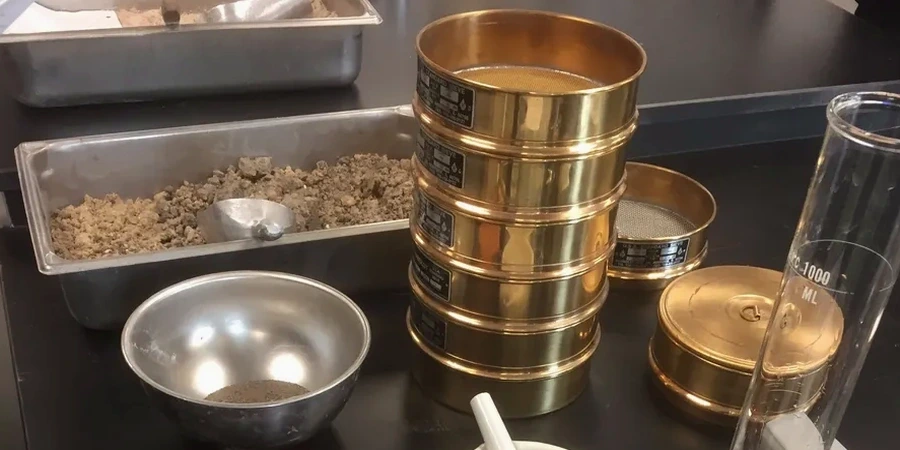
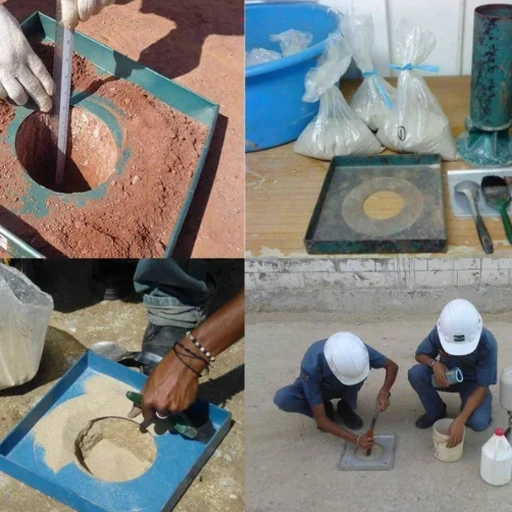
Pomona’s population passed 145,000, and with infill development accelerating near the 71 and 10 freeway corridors, we are seeing tighter lots and heavier structural loads on sites that were bypassed decades ago because the soil was considered marginal. A shallow foundation here has to work within the seismic framework of ASCE 7 Chapter 12 and the California amendments in CBC Chapter 16—this is not a generic design. In our lab, we routinely run Atterberg limits and sieve analyses on Pomona samples to classify the material per ASTM D2487, then feed those parameters into bearing capacity equations that account for the site’s seismic site class. When the upper 10 feet shows loose to medium-dense sand, we often recommend complementary field verification with a plate load test to confirm the modulus of subgrade reaction before finalizing footing dimensions.
Shallow Foundation Design in Pomona — Geotechnical Expertise for Local Soils
Technical reference — Pomona

Local geotechnical context

ASCE 7-22 Section 11.4.8 kicks in hard for Pomona sites classified as Site Class D or E—the design spectral accelerations get amplified significantly, and a shallow foundation that was adequate under static conditions can become marginal once seismic demands are applied. The risk we flag most often is differential settlement under cyclic loading: silty layers that look competent in a hand sample can lose stiffness during shaking, leading to tilt or distress in lightly reinforced footings. Ignoring the liquefaction susceptibility of shallow Holocene deposits, even when the groundwater is deep, is another pitfall; we run simplified procedures based on Seed & Idriss (1971) and updated NCEER guidelines to check factor of safety against liquefaction triggering. In Pomona, a foundation report that skips this step is not worth the paper it is printed on.

Need a geotechnical assessment?

Reply within 24h.

Email: info@geotechnicalengineering1.com

Relevant standards

ASCE 7-22 Minimum Design Loads and Associated Criteria for Buildings and Other Structures, 2022 California Building Code (CBC) Chapter 16 & 18, based on IBC, ASTM D1586 Standard Test Method for Standard Penetration Test (SPT) and Split-Barrel Sampling of Soils, ASTM D2487 Standard Practice for Classification of Soils for Engineering Purposes (Unified Soil Classification System)

Typical values

ParameterTypical value
Allowable bearing pressure (SPT-based, N=15)2,500 – 3,500 psf
Typical footing embedment depth18 – 36 inches below grade
Seismic site class range (Pomona)C to D per ASCE 7-22
Settlement analysis methodSchmertmann (1978) with strain influence factor
Minimum footing width (residential)18 inches per CBC §1809
Soil classification standardASTM D2487 Unified Soil Classification
Groundwater depth (typical, east Pomona)> 30 ft below ground surface

Common questions

What is the typical allowable bearing pressure for a shallow foundation in Pomona?

For a standard spread footing on medium-dense alluvial sand with an SPT N-value around 15, we typically assign an allowable bearing pressure in the range of 2,500 to 3,500 psf per our analysis under CBC and ASCE 7 provisions. However, this number adjusts significantly based on the actual N-values, fines content, and proximity to any buried stream channels. A site-specific geotechnical investigation is required to confirm the value for your parcel.

How much does a shallow foundation design package cost for a Pomona residential project?

For a single-family residential lot in Pomona, a complete shallow foundation design package—including SPT drilling, lab testing, bearing capacity calculations, and the stamped report—generally falls between US$1,820 and US$3,030, depending on the number of borings and the structural complexity. Add-on services like plate load testing or deeper exploration are quoted separately after an initial site review.

What depth of exploration do you need for a shallow foundation design?

Per CBC Section 1803, borings for shallow foundations should extend to a depth where the net stress increase from the footing is less than 10 percent of the existing overburden pressure, or to at least 20 feet below grade—whichever is deeper. In Pomona’s alluvial profile, we typically drill to 25 or 30 feet to capture any deeper loose layers that could contribute to settlement.

How do you address the seismic requirements for shallow foundations in Pomona?

We determine the seismic site class from SPT N-values and shear wave velocity data per ASCE 7-22 Chapter 20, then apply the corresponding site coefficients Fa and Fv to the mapped spectral accelerations for Pomona’s coordinates. Bearing capacity reduction factors for seismic loading follow the one-third increase permitted by CBC when justified by transient load duration, but we verify that settlement under combined static-plus-seismic demand remains within tolerable limits.

Location and service area

We serve projects in Pomona and surrounding areas.

View larger map