GEOTECHNICALENGINEERING1
POMONA
HomeSlopes & WallsActive/passive anchor design

Active and Passive Anchor Systems for Southern California Slopes

Rigorous testing. Clear reporting.

LEARN MORE

In Pomona, the contact between young alluvium and the San Jose Hills creates subsurface conditions that shift dramatically over short distances. A tieback that holds in one part of the city may creep just half a mile south where the bedrock dips beneath saturated terrace deposits. We design active and passive anchors with this variability in mind. Every calculation starts with a proper geotechnical investigation. When the site sits near the base of the Puente Hills, we often recommend pairing the anchor design with a slope stability analysis to confirm that the bonded length sits beyond any potential failure surface. The goal is a restraint system that works under both static groundwater conditions and the seismic demand prescribed by ASCE 7 for a site just 30 miles east of downtown Los Angeles.

An anchor is only as reliable as the ground it bonds to, and in Pomona's alluvial fans that ground can change within a single tendon length.
Our service areas

Our approach and scope

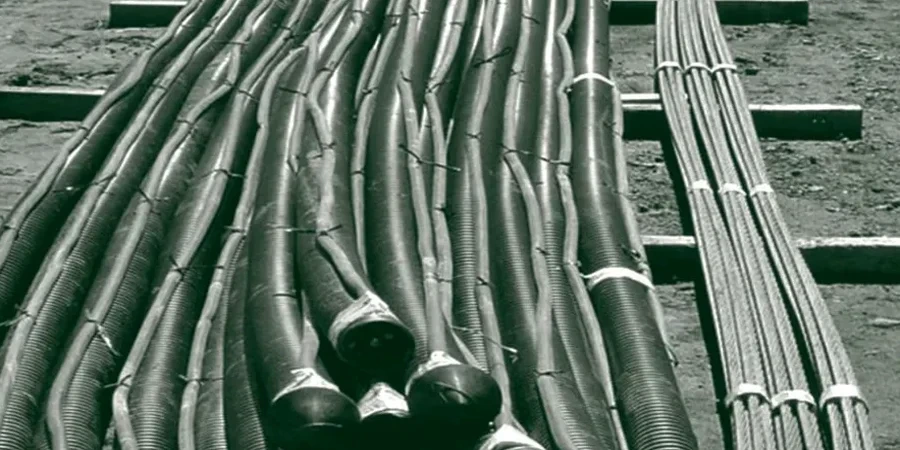
The Pomona climate contributes a specific challenge to anchor performance: extended dry summers followed by brief, intense winter rains that can raise the piezometric surface faster than drainage systems can respond. A passive anchor grouted into stiff clay in September may be working against completely different pore pressures by February. We address this by specifying double-corrosion protection for tendons installed in potentially aggressive soils, and by running pull-out tests that extend the hold period until creep stabilizes. Our load cells record data at one-minute intervals during proof testing, which lets us catch bond degradation before the anchor is locked off. For temporary excavations in the city's older commercial corridors, a mechanically connected plate anchor often proves more efficient than a deep grouted bond, especially where underground utilities restrict drilling angles.
Active and Passive Anchor Systems for Southern California Slopes
Technical reference — Pomona

Local geotechnical context

Pomona sits within the Peninsular Ranges geomorphic province, where the nearby Sierra Madre fault system can generate ground accelerations that unload the bonded zone of a passive anchor. A tieback designed without a site-specific seismic hazard analysis may appear to pass a short-term proof test yet fail during a moderate event. The city's older hillside developments add another layer of risk: undocumented fill with brick fragments and decomposed granite can mask the true refusal depth. We have encountered situations where a drill log showed competent material at 40 feet, but the anchor lost bond at 38 feet because the rig had pushed through a lens of reworked debris. Our response is to stagger tendon lengths across the wall profile and to instrument select anchors with vibrating wire load cells that provide long-term performance data.

Need a geotechnical assessment?

Reply within 24h.

Email: info@geotechnicalengineering1.com

Relevant standards

ASCE 7-22 Minimum Design Loads for Buildings and Other Structures, IBC 2021 (International Building Code), Chapter 18 Soils and Foundations, PTI DC35.1-14 Recommendations for Prestressed Rock and Soil Anchors, ASTM A416 Standard Specification for Low-Relaxation Steel Strand, ASTM D1586 Standard Test Method for SPT

Typical values

ParameterTypical value
Design standardASCE 7-22, IBC 2021
Anchor typeActive (prestressed) and passive (deadman)
Tendon steel gradeASTM A416 Grade 270 (low-relaxation strand)
Grout strength (min 28-day)4,000 psi per PTI DC35.1
Corrosion protectionClass I (double barrier) for permanent anchors
Proof test load133% of design load, per PTI recommendations
Creep criterion≤ 2 mm over 60 min at test load

Common questions

What is the typical cost range for anchor design on a retaining wall project in Pomona?

For a standalone anchor design package covering up to three wall sections with soil parameters already established, the fee typically falls between US$950 and US$4,120. The final cost depends on wall height, number of anchor rows, and whether proof testing supervision is included.

How does a site-specific seismic hazard analysis affect the anchor design?

The analysis provides the peak ground acceleration and spectral acceleration values at the anchor location. These numbers feed directly into the pseudostatic slope stability model and the anchor load calculations. Without this step, the design may underestimate the dynamic tension that develops in the tendon during an earthquake.

What is the difference between an active and a passive anchor?

An active anchor is tensioned against the wall after grouting to actively compress the soil mass behind it. A passive anchor develops resistance only when the wall moves enough to stretch the tendon. Active systems are preferred when deflection must be kept very small, such as near existing buildings in downtown Pomona.

How long does a proof test take and what are you looking for?

A standard proof test on a production anchor runs approximately one hour per anchor. We apply incremental loads up to 133% of the design load and hold each step while measuring creep with a dial gauge. The anchor passes if the creep rate stabilizes and total movement over 60 minutes stays below 2 mm.

Location and service area

We serve projects in Pomona and surrounding areas.

View larger map